 Commity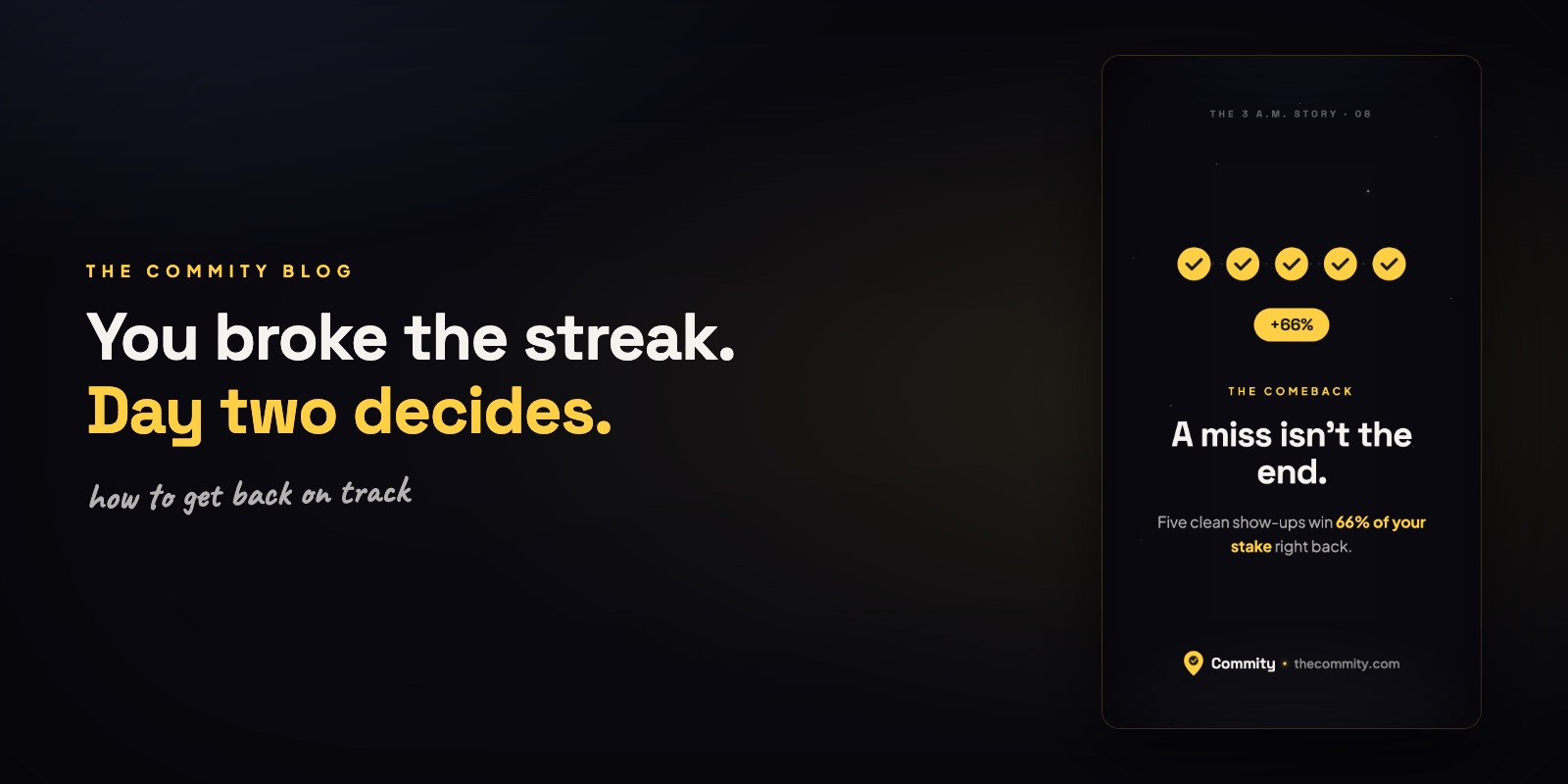
You had a run going. Eleven days, maybe nineteen. Then one day something reasonable happened — you were ill, you travelled, work ran long — and the chain broke. And now, a week and a half later, you haven't been back once.
That gap between "missed one day" and "stopped entirely" is the thing worth understanding, because almost nobody quits on purpose. The missed day is rarely the problem. What happens in your head the day after is.
The miss isn't what ends it. The spiral is.
Psychologists have a name for this pattern: the what-the-hell effect. Break a rule you'd set for yourself and the sensible response would be to shrug and continue. The actual response is usually to write the whole thing off — the streak is ruined, the plan is blown, so you may as well stop properly.
It's the same logic that turns one missed session into a lost month, and it runs on an assumption worth naming out loud: that the streak was the goal. It wasn't. The goal was to train, or study, or show up. The streak was a scoreboard. Losing the scoreboard doesn't undo eleven days of work — those happened, they're still in your body and your notes, and no counter resetting to zero takes them back.
You didn't lose the progress. You lost the number that was tracking it.
Day two is where the real decision happens
Missing once is an event. Missing twice is a pattern, and the difference between them is enormous — it's the point where "I had a bad day" quietly becomes "I don't do this anymore."
Which is why the most useful rule in all of this is also the simplest: never miss twice in a row. You don't need a perfect record. You need a hard ceiling on how long a gap is allowed to get. One missed Tuesday is noise. A missed Tuesday and Wednesday is how habits end.
If you're reading this three weeks into a gap, that rule hasn't expired — it just applies from now. The next scheduled day is the one that counts.
Shrink the re-entry until it's embarrassing
Here's the trap that keeps people stuck: the comeback session gets designed as compensation. You missed a week, so you'll do a long session to make up for it — and because that's daunting, you don't do it at all, which extends the gap, which makes the imagined make-up session even bigger. That loop can run for months.
Break it by making the first day back deliberately, almost insultingly small:
- Twenty minutes at the gym. Not a workout — an attendance.
- One page, or fifteen minutes of study. Not a chapter.
- Show up, do the minimum, leave early. On purpose.
The first session back isn't there to produce results. It's there to prove that the thing still exists and you're still someone who does it. Results resume on day three, once you're actually going again.
Keep the place and the window. Change the size.
When a routine collapses, the instinct is to redesign it — new schedule, new program, new app, fresh start Monday. Resist that. The place and the time were probably fine; a redesign mostly buys you the pleasant feeling of planning, which is not the same as the unpleasant feeling of going.
So keep the coordinates identical — same gym, same library, same hour — and change only the target. If five days a week broke under a normal amount of life, it wasn't the right number. Come back at three. Three days a week that survive a bad month beat five days that collapse every time something happens.
A schedule you keep at 60% is worth more than one you abandon at 100%.
Give the comeback a deadline and something at stake
"I'll get back to it" is not a plan; it's a feeling with no date attached. Restarts need the same structure the original habit needed — arguably more, because the enthusiasm that carried the first attempt is gone.
So put a boundary on it. Not "I'll start again soon," but: the next scheduled day, at the usual time, at the usual place, with the small version of the session. Then give it a consequence that lands the same day, because a restart with no cost attached is exactly as skippable as the days you just missed. That's the whole argument for putting money on the line — it doesn't make you want it more, it makes quitting the expensive option.
This is also the part most habit apps get wrong. Break a streak and you get a counter reset to zero, which is the least motivating possible response: it deletes your history and gives you nothing to aim at except a distant number you already hit once.
Commity handles a miss differently. If you miss a scheduled day, your stake is charged — but that isn't the end of it. You get a comeback: five clean show-up days in a row wins up to 66% of your stake back. Miss a single one of those comeback days and the comeback ends with no win-back, which is the part that makes it work. It's not a free pass — it's a short, concrete, high-stakes runway that turns "I blew it" into a five-day target you can actually see the end of.
Stop counting from zero
One more reframe, because the streak counter does real psychological damage on the way down.
Instead of a chain that a single miss destroys, count total days shown up. Nineteen sessions is nineteen sessions whether they came in a perfect row or with three gaps in the middle. That number only ever goes up, which means a bad week can slow you down but can never wipe you out — and it's a far more honest measure of what you've actually done.
The people who stay consistent for years aren't the ones who never miss. They're the ones whose misses stay one day long.
The short version
- The miss didn't end it. Two in a row would.
- Go back on the next scheduled day — not Monday, not next month.
- Make the first session back small enough that you can't talk yourself out of it.
- Keep the place and the time; lower the target if the old one kept breaking.
- Give the restart a real deadline and something on the line.
- Count total days, not consecutive ones.
If you want the system to run this for you rather than holding it together yourself, that's what Commity does: pin your place, pick your days, back it with a stake, and prove it with a GPS check-in. Show up and it costs you nothing. Miss one and the comeback is right there waiting. If you're rebuilding from scratch, this is how to build consistency from the ground up — and this is how to keep yourself honest once you've started.
You're not starting over. You're continuing, with one gap in the record. Go on the next scheduled day.